Decode Your Auto Loan: A Guide to Rates, Terms, & APR
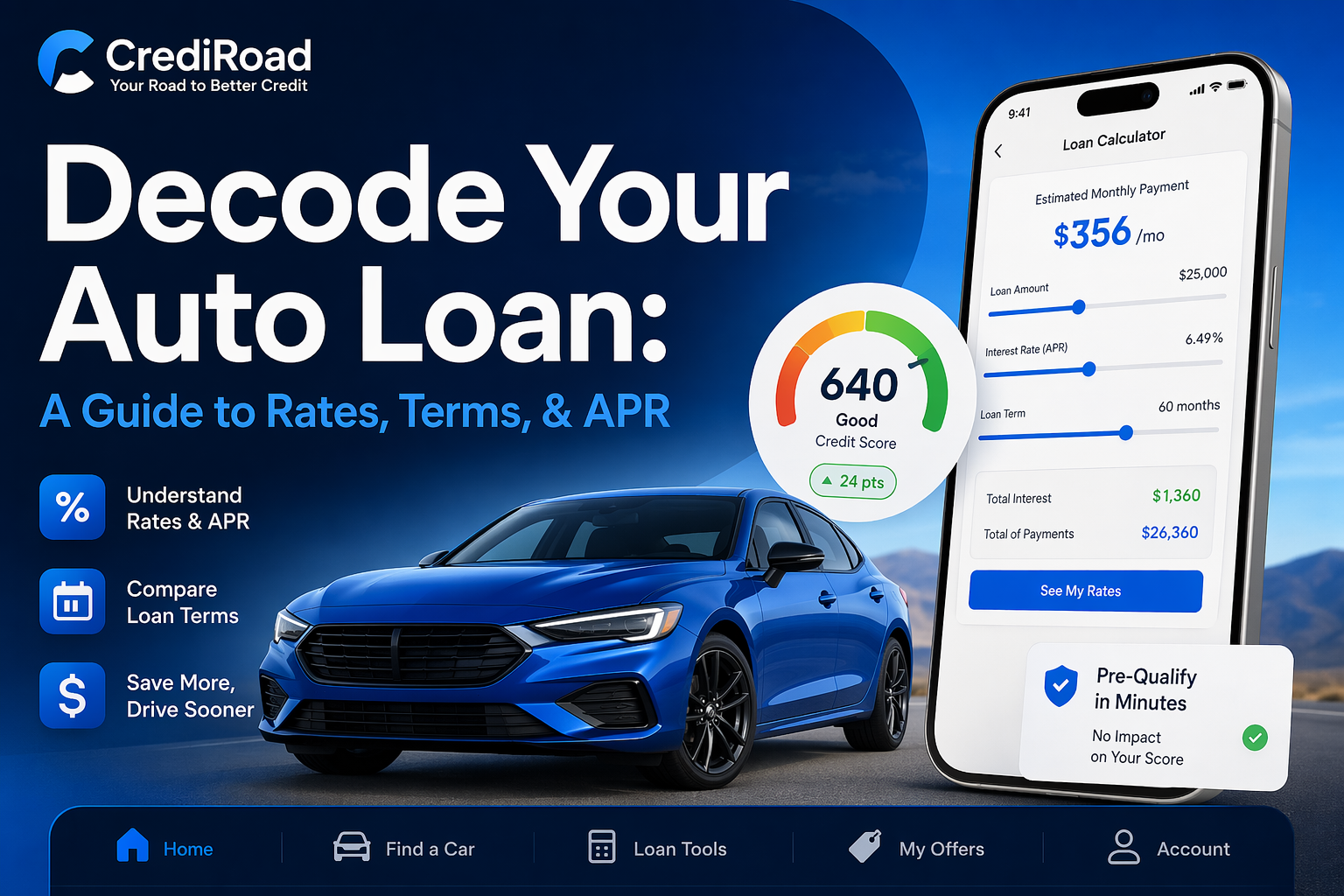
Buying a car is an exciting milestone, but navigating the world of auto financing can quickly turn that excitement into confusion. Understanding auto loan terms is crucial, yet many buyers feel overwhelmed by the jargon: interest rates, APR, principal, loan terms – what does it all mean for your wallet? Without a clear grasp of these fundamental concepts, you might unknowingly agree to a deal that costs you thousands more over the life of your loan.
This comprehensive guide will break down the essential components of any car loan, empowering you to make informed decisions. We'll demystify key terms like your car loan interest rate and the annual percentage rate (APR), explain how they impact your total payments, and guide you through choosing the right loan term. By the end, you'll be equipped to confidently negotiate, avoid hidden fees, and secure an affordable vehicle that fits your budget. Let CrediRoad help you simplify your auto financing journey.
Essential Auto Loan Vocabulary Every Buyer Needs to Know
Before you sign any paperwork, it's vital to understand the language of auto loans. These terms directly affect how much you pay, for how long, and your overall financial commitment. Grasping these definitions is the first step towards a smarter car purchase.
Principal: The Core of Your Loan
The principal is the initial amount of money you borrow to purchase your car. This is the actual cost of the vehicle after any down payment or trade-in value has been deducted. For example, if you buy a $25,000 car and put down $5,000, your loan principal would be $20,000. Your monthly payments will eventually pay off this principal amount, along with the added interest.
Interest Rate: The Cost of Borrowing
The interest rate is the percentage charged by the lender for the money you borrow. It's expressed as a percentage of the principal and dictates how much extra you pay back on top of the original loan amount. A lower interest rate means lower monthly payments and less money paid over the life of the loan. This rate is usually determined by factors like your credit score, market conditions, and the lender's risk assessment. A strong credit history can significantly reduce the car loan interest rate you're offered.
APR (Annual Percentage Rate): The True Cost of Your Loan
While the interest rate tells you the cost of borrowing the principal, the Annual Percentage Rate (APR) gives you a more complete picture of the total cost of your loan. The APR includes the interest rate plus any additional fees associated with the loan, such as origination fees, administrative charges, or other costs rolled into the financing. Comparing APRs from different lenders is often more accurate than just comparing interest rates, as it reflects the true yearly cost. Always ask lenders for the APR, not just the interest rate, to ensure you're getting a clear picture of the total cost.
Loan Term: How Long You'll Pay
The loan term refers to the length of time, typically expressed in months, over which you agree to repay the loan. Common terms range from 36 to 84 months. A shorter loan term generally means higher monthly payments but less interest paid overall, as you're borrowing the money for a shorter period. Conversely, a longer loan term offers lower monthly payments, making the car more "affordable" in the short term, but you'll pay more in total interest over the life of the loan.
Down Payment and Trade-in: Reducing Your Principal
A down payment is the upfront cash you pay towards the car's purchase price. A larger down payment reduces the principal you need to borrow, which can lead to lower monthly payments and less interest paid over time. Similarly, trading in your old vehicle can serve as a down payment, offsetting the new car's cost. Both strategies are excellent ways to minimize your loan burden and secure more favorable terms.
How Interest Rates and APR Truly Affect Your Total Cost
Understanding the difference between the interest rate and the Annual Percentage Rate (APR) is fundamental to securing a good auto loan. Many car buyers make the mistake of only looking at the stated interest rate, missing the full financial picture that the APR provides. This oversight can lead to unexpected costs and a higher total repayment.
Interest Rate vs. APR: What's the Real Difference?
As we discussed, the interest rate is solely the cost of borrowing the principal. It's the percentage applied to the amount you owe, typically calculated monthly. The APR, however, encompasses the interest rate plus other mandatory fees charged by the lender. These fees can include loan origination fees, documentation fees, processing fees, and sometimes even credit report fees. Lenders are legally required to disclose the APR, making it the most accurate figure to use when comparing loan offers.
For example, two lenders might offer you a 6% interest rate. However, Lender A has no additional fees, making their APR also 6%. Lender B, on the other hand, might have $500 in processing fees, which when factored into the loan over its term, could push their APR up to 6.5%. While the monthly payment difference might seem small, over several years, this can add up. Always compare the APR, not just the interest rate, to ensure you're getting the best overall deal. For a deeper dive into preparing for your loan, consider reading about Auto Loan Prequalification vs. Pre-approval: What You Need to Know.
Calculating Your Total Cost: Beyond the Monthly Payment
When evaluating an auto loan, it's easy to focus solely on the monthly payment. While essential for budgeting, it doesn't tell you the total amount you'll pay back. The total cost of your loan includes the principal, plus all the interest and fees bundled into the APR. A simple way to estimate your total repayment is to multiply your monthly payment by the number of months in your loan term.
Let's say you borrow $20,000 at a 7% APR over 60 months. Your estimated monthly payment might be around $400. Over 60 months, you would pay back a total of $24,000 ($400 x 60), meaning you paid $4,000 in interest and fees. If you were able to secure a 5% APR, your payment might drop to $377, and your total repayment would be $22,620, saving you over $1,300. CrediRoad's Auto Loan Calculator & Budgeting Tools: Plan Your Perfect Ride's Finances can help you run these scenarios and plan your budget effectively.
The Impact of Your Credit Score on Rates
Your credit score plays a significant role in the interest rate and APR you're offered. Lenders use your credit score to assess your creditworthiness – essentially, how likely you are to repay the loan. A higher credit score (typically 670 and above) indicates a lower risk to lenders, often qualifying you for the lowest available rates. Conversely, a lower credit score (like those in the 480-680 range that CrediRoad specializes in) will generally result in a higher interest rate and APR, as lenders perceive a greater risk.
Even with a less-than-perfect credit score, options exist. Platforms like CrediRoad specialize in helping individuals with fair or bad credit connect with lenders willing to work with them. Improving your credit score before applying can save you a substantial amount of money. Resources like The Ultimate Guide to Rebuilding Credit with an Auto Loan can provide actionable steps to boost your score and secure better terms.
Choosing the Right Loan Term Length: Short vs. Long
The loan term, or the repayment period, is a critical factor that directly influences both your monthly payment and the total cost of your auto loan. There's a constant trade-off between keeping monthly payments low and minimizing the overall expense. Understanding this balance is key to making a smart financial choice.
Short Loan Terms: Higher Payments, Lower Total Cost
Short loan terms, typically 36 to 48 months, come with several advantages. The most significant benefit is that you'll pay less interest over the life of the loan. Since you're borrowing the money for a shorter duration, the lender has less time to accrue interest charges. This translates to substantial savings in the long run. Additionally, you'll own your car outright much sooner, freeing up your budget for other financial goals.
However, the primary drawback of a short loan term is the higher monthly payment. For many buyers, especially those managing tight budgets, these higher payments can be a significant hurdle. Before committing to a shorter term, ensure your monthly income can comfortably accommodate the payment, leaving room for unexpected expenses. Missing payments can severely damage your credit.
Long Loan Terms: Lower Payments, Higher Total Cost
Longer loan terms, often stretching to 72 or even 84 months, offer the immediate benefit of lower monthly payments. This makes more expensive vehicles seem more "affordable" on a month-to-month basis and can be a lifeline for individuals with budget constraints or those looking to reduce their debt-to-income ratio.
The trade-off, however, is significant. You will end up paying much more in total interest over the extended period. Because the principal balance remains outstanding for longer, interest continues to accrue. Longer terms also increase the risk of becoming "upside down" on your loan, meaning you owe more than the car is worth, particularly in the early years of ownership when depreciation is highest. This can create complications if you need to sell or trade in the vehicle before the loan is paid off.
Finding Your Balance: What's Right for You?
The ideal loan term is a personal decision based on your financial situation, priorities, and tolerance for risk.
- If your budget allows for higher monthly payments, a shorter term will save you money on interest and get you to debt-free ownership faster.
- If you need to keep monthly expenses low, a longer term might be necessary, but be aware of the increased total cost and the risk of negative equity.
It's wise to use an auto loan calculator to explore different scenarios. Play with various loan terms to see how they impact both your monthly payment and the total interest paid. Remember to factor in other car-related expenses like insurance, maintenance, and fuel. CrediRoad helps you explore options and secure a loan that aligns with your financial comfort. Unlock 26+ Auto Lenders: CrediRoad's Partner Comparison Network to compare diverse offers tailored to your needs.
Avoiding Hidden Fees and Fine Print in Your Auto Loan Contract
The excitement of getting a new car can sometimes overshadow the critical need to meticulously review your auto loan contract. Lenders are required to disclose all terms, but sometimes important details are buried in fine print or presented in a way that can be confusing. Being diligent before you sign is paramount to protecting your financial interests.
Common Fees to Watch For
Beyond the principal, interest, and APR, several other fees can inflate the cost of your auto loan. While some are legitimate and unavoidable, others might be negotiable or even unnecessary add-ons.
- Documentation Fees (Doc Fees): These cover the cost of preparing and processing your loan and sale paperwork. They vary widely by state and dealership, and while often legitimate, they can sometimes be inflated.
- Loan Origination Fees: Some lenders charge a fee for setting up the loan. This should be clearly reflected in the APR.
- Prepayment Penalties: Some loans penalize you for paying off your loan early. Always check for this if you anticipate wanting to pay off your car ahead of schedule.
- Late Payment Fees: Standard across most loans, but understand the grace period and fee structure.
- Extended Warranties/Service Contracts: Often offered at the financing stage, these are separate products that can be rolled into your loan, significantly increasing the total amount you finance. While some may offer value, ensure you understand what's covered and if it duplicates manufacturer warranties.
- Credit Insurance/GAP Insurance: Credit insurance pays your loan if you become disabled or die. GAP (Guaranteed Asset Protection) insurance covers the difference between what you owe on your loan and what your car is worth if it's totaled or stolen. Both can be valuable, but ensure they are optional and understand their cost and coverage before adding them to your loan.
- Etching or VIN Etching Fees: A charge for etching the Vehicle Identification Number (VIN) onto your car's windows as a theft deterrent. This is often an unnecessary and overpriced add-on.
Reading the Fine Print: Your Best Defense
Never rush through signing your auto loan contract. Take your time to read every section, no matter how small the font. If possible, ask for a copy of the contract to review at home or with a trusted advisor before coming in to sign. Pay close attention to:
- Total Amount Financed: Does this match the agreed-upon price of the car minus your down payment/trade-in, plus any legitimate fees you've agreed to?
- Interest Rate and APR: Reconfirm these figures match what was verbally communicated and what you expected.
- Loan Term: Ensure the number of months aligns with your understanding.
- Payment Schedule: Confirm the due dates and payment amounts.
- Specific Clauses: Look for any clauses regarding arbitration, repossession, or default conditions.
Asking the Right Questions
Don't be afraid to ask questions until you fully understand every line of the contract. A reputable lender or dealer will be happy to clarify. Ask:
- "What is the total amount I will pay over the life of this loan, including all interest and fees?"
- "Are there any prepayment penalties if I pay off the loan early?"
- "Can you itemize all fees included in the total amount financed?"
- "Are any of these fees or add-ons optional?"
- "What happens if I miss a payment?"
By being proactive and informed, you can significantly reduce the risk of unexpected costs and ensure your auto loan truly serves your best interests. Remember, getting Pre-Approved Fast: CrediRoad's Smart Auto Loan Matching Process can help you walk into the dealership with confidence, knowing your financing terms upfront.
Frequently Asked Questions About Auto Loan Terms
Q1: What is a good interest rate for an auto loan?
A "good" interest rate depends heavily on your credit score, market conditions, and the loan term. Generally, excellent credit (720+) might qualify for rates below 5-6% (or even lower, depending on the year 2026's rates). Fair credit (480-680) will typically see higher rates, perhaps in the 8-15% range or more, but the goal is to secure the lowest rate possible for your individual credit profile. Comparing multiple offers, like those available through CrediRoad, is key.
Q2: Is it better to have a higher interest rate or a longer loan term?
Neither is inherently "better" without considering your financial situation. A higher interest rate always costs you more overall. A longer loan term will also cost you more in total interest but results in lower monthly payments. If you prioritize lower monthly payments and can afford the higher total cost, a longer term with a reasonable rate might be suitable. If you want to minimize total cost and can manage higher payments, a shorter term is usually better.
Q3: Can I refinance my auto loan if I don't like the terms?
Yes, absolutely! Auto refinancing is a common strategy to secure better terms, especially if your credit score has improved since you first took out the loan, or if interest rates have dropped. Refinancing can potentially lower your interest rate, reduce your monthly payments, or even shorten your loan term. CrediRoad offers resources and options for auto refinancing to help you improve your loan terms.
Q4: Does getting pre-qualified for an auto loan affect my credit score?
No, typically getting pre-qualified for an auto loan involves a "soft inquiry" on your credit report, which does not negatively impact your credit score. This is a great way to gauge potential loan terms without commitment. A "hard inquiry" (which can slightly lower your score) only occurs when you formally apply for a loan. Get Prequalified for a Car Loan: No Impact on Your Credit Score explains this process in detail.
Q5: How much of a down payment should I make on a car?
While a down payment isn't always required, making one is highly recommended. A larger down payment reduces your loan principal, which means lower monthly payments and less interest paid over time. Aim for at least 10-20% of the vehicle's purchase price if possible. This also helps reduce the risk of being upside down on your loan.
Conclusion
Navigating the complexities of auto loan terms doesn't have to be daunting. By understanding the core concepts of principal, interest rate, APR, and loan term, you empower yourself to make smarter financial decisions. Remember, the goal is not just to find a car you love, but to secure financing that aligns with your budget and long-term financial health. Knowing how interest rates and APR truly affect your total cost, and carefully considering the impact of your loan term, will save you money and stress.
Don't let hidden fees and confusing jargon derail your car-buying journey. Take the time to read contracts thoroughly, ask questions, and utilize reliable tools to compare offers. At CrediRoad, we believe everyone deserves transparent and fair auto financing, regardless of their credit history.
Ready to take control of your auto loan? Let CrediRoad be your guide. Explore personalized loan offers, leverage our credit score simulator, and find the perfect financing solution for your next vehicle. Find your perfect ride and get pre-approved for an auto loan today!