Types of Auto Loans Explained: Which One is Right for You?
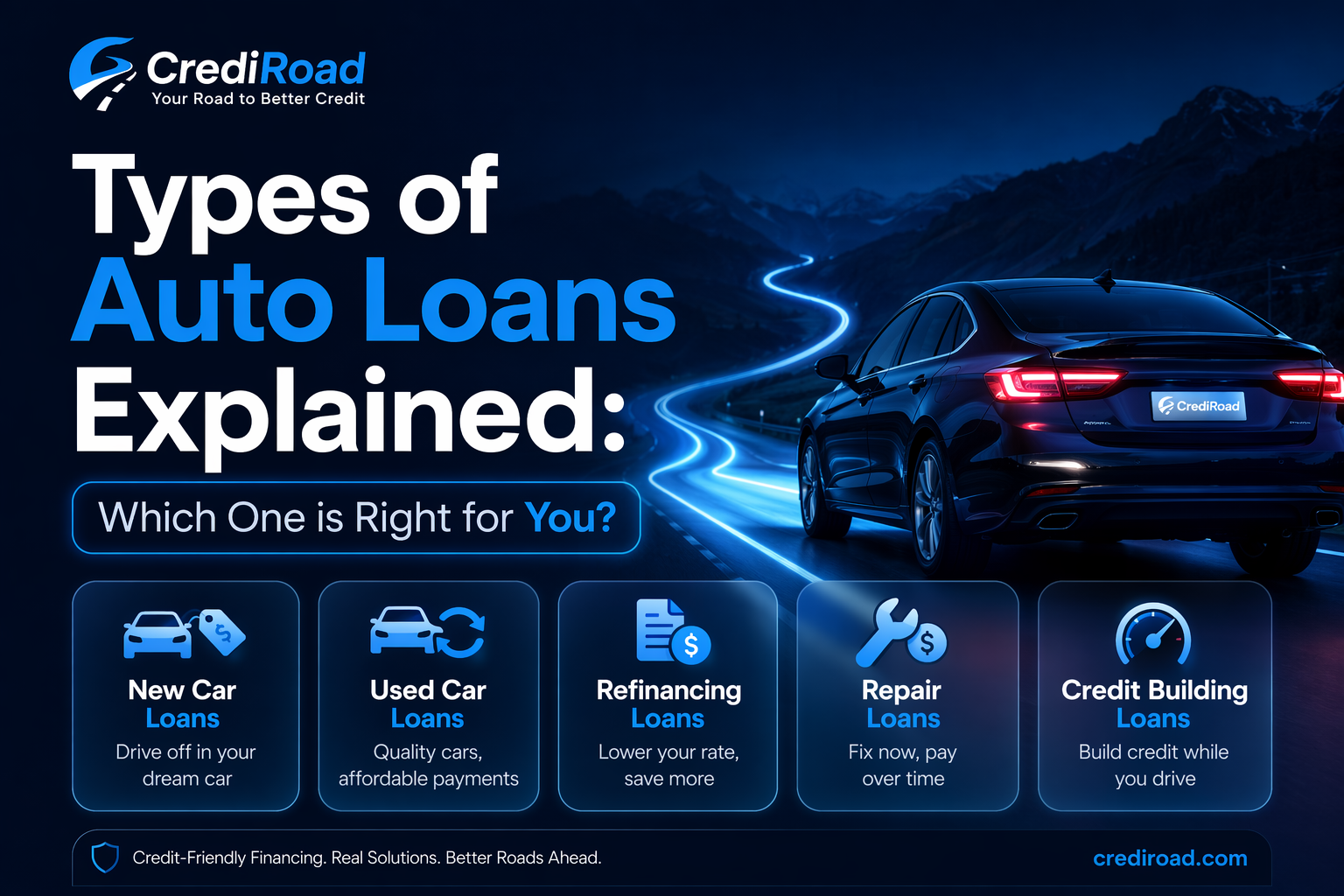
Navigating the world of car financing can feel like deciphering a complex financial roadmap. With so many options available, from various lenders to different loan structures, it’s easy to feel overwhelmed when trying to secure the best deal for your next vehicle. Understanding the fundamental types of auto loans is not just about getting approved; it's about making an informed decision that aligns with your financial goals and driving needs.
Whether you're eyeing a brand-new sedan, a reliable pre-owned SUV, or simply considering how to finance an essential repair, the type of loan you choose will significantly impact your monthly payments, total cost, and even your long-term financial health. Knowing your options empowers you to negotiate better terms and avoid pitfalls. In this comprehensive guide, we'll break down the various auto loan structures, explain key financial terms, and help you determine which financing path is truly right for you in 2026.
At CrediRoad, we believe everyone deserves access to clear, credit-friendly vehicle financing. Let's demystify car loans together, ensuring you make the smartest choice for your personal situation.
Secured vs. Unsecured Auto Loans: Understanding the Collateral
One of the most fundamental distinctions in car financing lies between secured and unsecured auto loans. This difference primarily centers on whether an asset, in this case, the vehicle itself, is used as collateral for the loan. Your credit profile and the lender's risk assessment often dictate which type of loan you'll be offered.
What is a Secured Auto Loan?
The vast majority of traditional auto loans are secured loans. This means the vehicle you are purchasing serves as collateral for the loan. If you fail to make your payments, the lender has the legal right to repossess the car to recover their losses. This arrangement reduces the risk for the lender, which often translates to lower interest rates and more favorable terms for the borrower, especially if you have a good credit score. For individuals with challenged credit, secured auto loans are often the most accessible path to car ownership, as the collateral mitigates some of the lender's risk.
What is an Unsecured Auto Loan?
An unsecured auto loan, on the other hand, does not require any collateral. These loans are typically personal loans that can be used for any purpose, including buying a car. Because there's no asset for the lender to seize if you default, unsecured loans carry a higher risk for the financial institution. Consequently, they usually come with higher interest rates and stricter eligibility requirements, often reserved for borrowers with excellent credit histories. While they offer flexibility, their higher cost generally makes them less attractive for vehicle purchases compared to secured options.
Why Most Car Loans are Secured
Secured loans are the standard for auto financing because they protect lenders from potential losses. For borrowers, this means that even with less-than-perfect credit, securing a vehicle loan is often possible. CrediRoad specializes in connecting individuals, including those with Bad Credit Auto Loans in 2026: Your Path to Car Ownership, with lenders who offer credit-friendly, secured financing solutions. Our goal is to ensure that having challenged credit doesn't keep you from getting on the road.
New Car vs. Used Car Financing: Key Differences
The choice between buying a new or used car not only affects the price of the vehicle but also the terms and availability of your financing. Lenders view new and used car loans differently due to factors like depreciation, reliability, and market value.
New Car Loan Considerations
Financing a new car often means access to lower interest rates and longer loan terms, especially if you have good credit. Manufacturers frequently offer promotional interest rates (e.g., 0% APR for qualified buyers) to boost sales of new models. However, new cars depreciate rapidly, meaning you could owe more on the loan than the car is worth, particularly in the early years. Lenders are often more willing to finance new cars because their value is easily quantifiable and they typically come with warranties, reducing immediate repair risks.
Used Car Loan Considerations
Used car loans, while often for a lower principal amount, can sometimes carry slightly higher interest rates than new car loans. This is because used cars can be seen as a higher risk by lenders due to their age, mileage, and potential for unforeseen mechanical issues. Loan terms for used cars might also be shorter than those for new vehicles. Despite this, buying a used car can be a financially savvy move, as you avoid the initial steep depreciation. CrediRoad helps bridge the gap, connecting you to lenders offering competitive rates for both new and used vehicles, including options for First-Time Car Buyer Loans: Your Guide to Getting on the Road with favorable terms.
Impact on Loan Approval
Your credit score plays a significant role in both new and used car financing. Lenders use it to assess your risk. A strong credit history opens doors to the best rates for either option. However, if your credit is challenged, you might find more flexible options in the used car market, as the lower overall price point can make approval easier. CrediRoad can help you understand these nuances and pre-qualify you for suitable options, regardless of whether you're eyeing new or used models.
Leasing vs. Buying: A Financial Breakdown
When considering vehicle acquisition, many people weigh the pros and cons of leasing versus buying. While buying involves securing an auto loan for ownership, leasing is essentially a long-term rental agreement. Each option has distinct financial implications and suits different lifestyles and priorities.
What is Leasing?
Leasing a car means you pay to use the vehicle for a set period (typically 2-4 years) and a predetermined number of miles. You don't own the car, and your monthly payments are based on the depreciation of the vehicle during your lease term, plus taxes and fees.
- Pros of Leasing:
- Lower monthly payments compared to buying a similar new car.
- You always drive a new car, enjoying the latest features and safety technology.
- Warranty coverage typically lasts the entire lease term, minimizing repair costs.
- No hassle of selling the car at the end of the lease; you simply return it or buy it out.
- Cons of Leasing:
- You never own the vehicle or build equity.
- Mileage restrictions can incur hefty fees if exceeded.
- Excessive wear and tear charges can apply at lease end.
- Early termination fees are usually substantial.
What is Buying?
Buying a car, whether new or used, means you take out a loan to cover the purchase price, and once the loan is paid off, you own the vehicle outright. This gives you full control and equity.
- Pros of Buying:
- You own the vehicle once the loan is paid off, building equity.
- No mileage restrictions or wear and tear penalties.
- Freedom to customize the vehicle as you wish.
- Can sell or trade-in the vehicle at any time.
- Cons of Buying:
- Higher monthly payments compared to leasing.
- Responsible for all maintenance and repairs once the warranty expires.
- Vehicle depreciation impacts your equity over time.
- Selling or trading in the car can be a hassle.
Which Option is Right for You?
The choice between leasing and buying depends on your financial situation and driving habits. If you enjoy driving new cars, have predictable driving patterns, and prefer lower monthly payments without the commitment of ownership, leasing might be appealing. However, if you prefer ownership, plan to drive many miles, or want to keep your car for a long time, buying is usually the more financially sound choice. CrediRoad primarily focuses on securing auto loans for purchases, empowering you with the path to ownership and financial growth.
Understanding Interest Rates, APR, and Loan Terms
When you're comparing different types of auto loans, three crucial financial terms will consistently appear: interest rate, Annual Percentage Rate (APR), and loan terms. Understanding these concepts is vital to accurately assess the true cost of your car loan and choose the most affordable option.
Interest Rate vs. Annual Percentage Rate (APR)
The interest rate is simply the percentage charged by the lender for borrowing the principal amount. It's the primary cost of borrowing money. However, the Annual Percentage Rate (APR) provides a more comprehensive measure of the total cost of your loan. The APR includes the interest rate plus any additional fees associated with the loan, such as administrative fees, origination fees, or closing costs, expressed as a single annual percentage.
- Why APR matters more: While an interest rate might look attractive, a higher APR indicates that additional fees are significantly increasing your overall borrowing cost. Always compare APRs when evaluating loan offers to get the most accurate picture of what you'll pay.
Decoding Loan Terms
The loan term refers to the length of time you have to repay the loan, typically expressed in months (e.g., 36, 48, 60, 72, or even 84 months). The loan term directly impacts your monthly payment and the total amount of interest you'll pay over the life of the loan.
- Shorter Loan Terms:
- Pros: Pay less interest overall, pay off the loan faster, build equity quicker.
- Cons: Higher monthly payments.
- Longer Loan Terms:
- Pros: Lower monthly payments, making the car more "affordable" on a monthly basis.
- Cons: Pay significantly more interest over the life of the loan, take longer to build equity, higher risk of being upside down on the loan (owing more than the car is worth).
Factors Influencing Your Rates and Terms
Several factors determine the interest rate and loan term you'll be offered:
- Credit Score: Your creditworthiness is the most significant factor. A higher credit score signals lower risk to lenders, resulting in lower interest rates and more flexible terms. Understanding Your Credit Score: Impact on Auto Loan Rates in 2026 is crucial for securing favorable financing.
- Debt-to-Income Ratio: Lenders assess your ability to manage monthly payments.
- Loan Amount and Down Payment: A larger down payment reduces the principal, potentially leading to better terms.
- Vehicle Age and Type: New cars often get better rates than older used cars.
- Economic Conditions: Broader interest rate trends set by central banks also play a role.
CrediRoad's tools, like our Boost Your Credit & Drive Away: CrediRoad's Simulator & Loan Calculator, can help you understand how different scenarios impact your potential loan terms and monthly payments, empowering you to make strategic decisions.
Frequently Asked Questions About Auto Loans
Navigating auto loan options can raise many questions. Here are some of the most common inquiries to help clarify your path to vehicle ownership.
Q: Can I get an auto loan with bad credit?
A: Yes, it is absolutely possible to get an auto loan with bad credit. Many lenders specialize in "subprime" auto loans for individuals with challenged credit histories. While interest rates may be higher, platforms like CrediRoad connect you with a network of lenders experienced in offering credit-friendly vehicle financing. Preparing with a down payment or a co-signer can also improve your chances.
Q: What is pre-qualification, and why is it important?
A: Auto loan pre-qualification is a preliminary assessment by a lender to see what loan terms you might qualify for, based on a soft credit inquiry that doesn't impact your credit score. It gives you an estimate of the loan amount, interest rate, and monthly payment you can expect. This is incredibly important because it allows you to shop for a car with a clear budget in mind, strengthening your negotiating position at the dealership. Get Prequalified for a Car Loan: No Impact on Your Credit Score explains this process in detail.
Q: Should I get a long-term or short-term auto loan?
A: The best loan term depends on your financial priorities. A short-term loan (e.g., 36-48 months) means higher monthly payments but significantly less interest paid over the life of the loan, saving you money in the long run. A long-term loan (e.g., 72-84 months) offers lower monthly payments, making it easier to fit into a tight budget, but you'll pay more in total interest and take longer to build equity. Consider your budget, desired total cost, and how long you plan to keep the car.
Q: Can I refinance my auto loan if I have bad credit?
A: Yes, auto loan refinancing for bad credit is possible and can be a smart move, especially if your credit has improved since you first took out the loan. Refinancing can potentially lower your interest rate, reduce your monthly payments, or change your loan term. It's an excellent way to Trade-In Your High-Interest Loan: Auto Refinancing for Bad Credit and improve your financial situation.
Your Path to the Right Auto Loan Starts Here
Choosing the right type of auto loan can feel like a major decision, and indeed it is. From understanding the fundamental differences between secured and unsecured options to weighing the benefits of new versus used car financing, and even deciphering the nuances of interest rates and loan terms, every piece of knowledge you gain empowers you. By thoughtfully considering your financial situation, credit health, and driving needs, you can confidently select the financing solution that best suits you.
Don't let the complexities of car financing deter you from finding the perfect vehicle. CrediRoad is designed to simplify this journey, providing clear, credit-friendly vehicle financing for everyone. Our platform helps you understand your options, compares personalized offers from a wide network of lenders, and even provides tools to help you manage and build your credit. Ready to find a loan that works for you? Begin your stress-free car financing journey today. Unlock Your Dream Car: Credit-Friendly Vehicle Financing for Everyone with CrediRoad and FindMyPerfectRide.